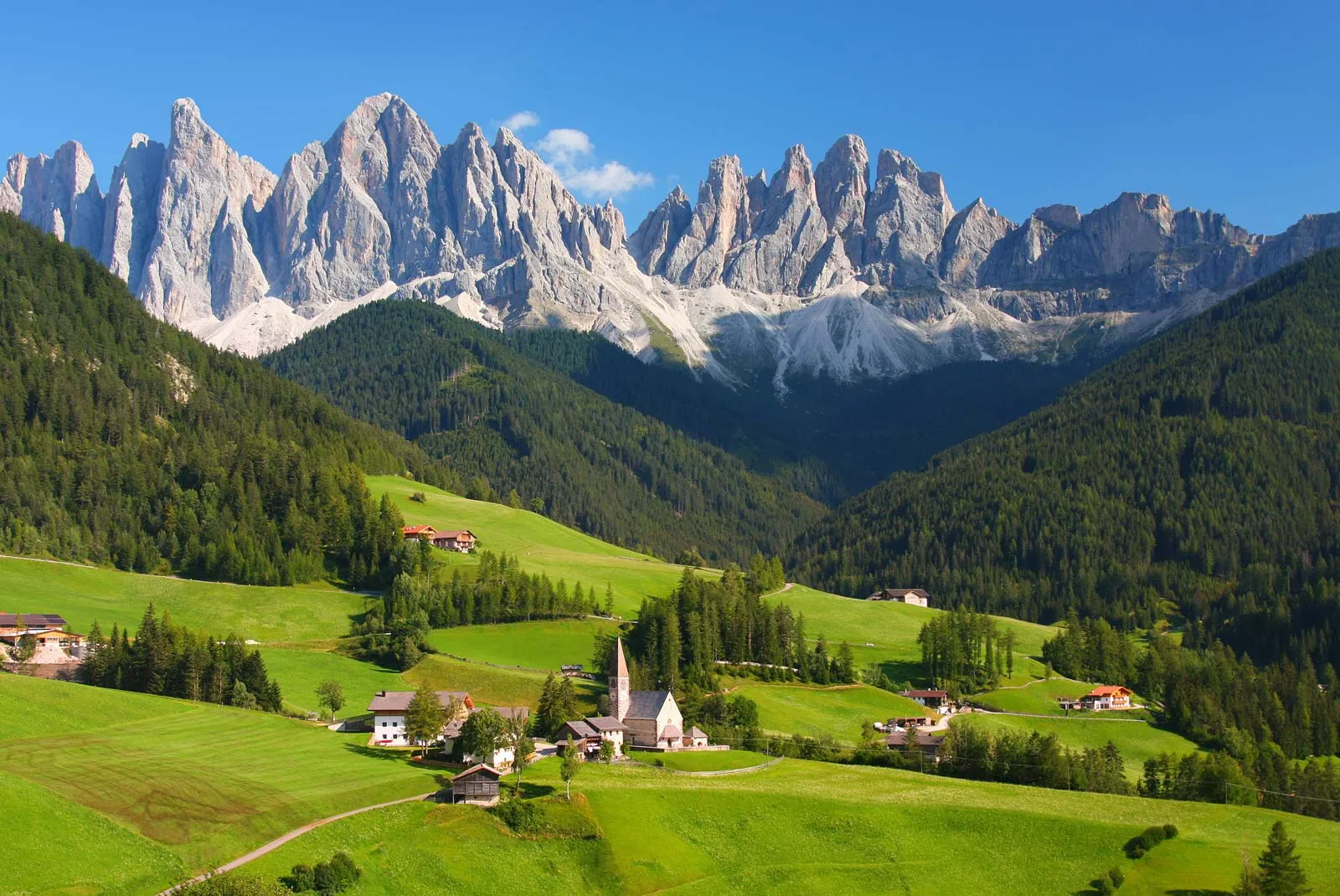
The Dolomites announce themselves slowly. You land in Venice or Innsbruck, and the transfer climbs for two hours through Prosecco vineyards, then alpine orchards, then narrowing valleys, until the pale limestone walls of the range start lifting over the road. UNESCO recognized the geology in 2009. What stays with you is the colour: at sunset the rock blushes rose-pink for ten minutes (a phenomenon locals call enrosadira), and from any decent hotel terrace you can watch it happen with a glass of Lagrein in your hand.
The range carries two cultures inside a 90-minute drive. Cortina d’Ampezzo, in the Veneto, is Italian-feeling and unrepentant about it: fur at Christmas, aperitivo along Corso Italia, white truffle on the menu in season, the dolce-vita scene the Milanese still fly in for. Across the Falzarego pass into South Tyrol, the register changes. The language drifts to Ladin and German. The pace slows. The food turns more deliberate (the province holds more Michelin stars per capita than anywhere else in Italy). Alta Badia and Val Gardena are the centres of gravity here, and the wellness facilities are some of the most ambitious in the Alps. February 2026’s Milan-Cortina Olympics put a year of additional attention on the destination, and the independent houses are where that attention found its best return.
What follows is eight independent or family-owned houses across the range. We left the Marriott, Aman, and other branded options off the list on purpose. The Dolomites are one of the few destinations in luxury Europe where the family operators are still meaningfully ahead of the chain alternatives on the things that matter: the cellar, the design language, the rhythm of service. The list is curated, not ranked, and it is grouped by area, because anyone who has been here twice picks on geography first.
At a glance
Resort | Area | From $/night | Best for |
|---|---|---|---|
Hotel de Len | Cortina d’Ampezzo | $577 | Design-savvy younger luxury travelers |
Hotel Faloria Mountain Spa | Cortina d’Ampezzo | $439 | Ski-first travelers with a modern base |
Ciasa Salares | San Cassiano, Alta Badia | $378 | Oenophiles, repeat-visitor types |
La Perla | Corvara, Alta Badia | $486 | Cultural immersion, Michelin pilgrims |
Adler Spa Resort Dolomiti | Ortisei, Val Gardena | $215 | Multigenerational families, serious spa-goers |
Forestis | Plose, above Brixen | $830 | Design-led wellness travelers |
Alpin Panorama Hotel Hubertus | Olang, Kronplatz | $262 | Instagram-era luxury travelers and couples |
Lefay Resort & SPA Dolomiti | Pinzolo, Trentino | $540 | Detox and wellness retreat seekers |
Hotel de Len
From | $577/night |
Best for | Design-savvy younger luxury travelers, the Soho House demographic |
Location | Central Cortina d’Ampezzo, a block from Corso Italia |
Rooms | 25 rooms and suites; categories from 23-sqm balcony rooms to terrace suites |
Standout amenity | A clandestine ground-floor cocktail bar and a rooftop spa overlooking the 2026 Olympic ski venues; the name means “of Wood” in Ladin |
Why we picked it. Hotel de Len is the most discussed new opening in the Dolomites. It is a full 2022 ground-up rebuild of the former Hotel Impero by an independent owner, with biophilic interiors paneled in reclaimed stone pine and old fir. Every public space was designed to read like a private alpine residence, which is why the Soho House and Aman set has adopted it as the new Cortina default.
The experience. All 25 rooms have balconies or terraces. The materials palette is hand-cut wood, raw stone, brass, and bouclé. The rooftop spa is small but well-edited (sauna, plunge pool, treatment room), with sightlines running straight to the Tofane and Cinque Torri. The ground-floor bar runs late and is locally popular, which is unusual for a hotel bar in Cortina.
Who it’s for, and who it isn’t. Built for younger luxury travelers who would rather have one perfect cocktail bar than a 7,000-sqm spa. Skip if you are traveling with kids. The 25-key footprint and adult bar scene are not a family fit.
Verdict. The Cortina address of the moment; book through Mr & Mrs Smith if you want the spa credit thrown in.
Hotel Faloria Mountain Spa Resort
From | $439/night |
Best for | Ski-first travelers who want a modern base |
Location | Zuel, Cortina d’Ampezzo, beside the 1956 Olympic ski-jump ramp |
Rooms | Approximately 48 rooms and suites, all with private balconies |
Standout amenity | A 1,000-sqm spa with what the property calls the largest heated semi-Olympic pool in the Dolomites |
Why we picked it. Faloria is the most ski-functional independent five-star in the Cortina valley. Contemporary product, roughly 48 keys with balconies on every room, and positioned beside the 1956 Olympic ski-jump ramp in Zuel, with the 2026 Olympic venues directly out the windows. The 1,000-sqm spa is built around what the hotel describes as the largest heated semi-Olympic pool in the Dolomites.
The experience. Rooms are modern alpine in style: wood and grey stone, balconies all around, and they skew larger than the Cortina norm. The spa adds a vitality pool, sauna, hammam, and treatment rooms. The kitchen is competent rather than headline-grabbing; the property’s leverage is in the spa and the ski access.
Who it’s for, and who it isn’t. Built for ski-first travelers who want a modern base outside the bustle of central Cortina. Skip if you want the historic-Cortina experience. Hotel de Len does that better.
Verdict. The contemporary spa-and-ski base for Cortina; the quietest of the Cortina picks.
Ciasa Salares
From | $378/night (approximate starting rate; published rates are by inquiry) |
Best for | Oenophiles and repeat-visitor types who value relationships over polish |
Location | San Cassiano, Alta Badia (South Tyrol), bordering UNESCO Fanes-Sennes-Braies park |
Rooms | 50 rooms and suites |
Standout amenity | The Cocun cellar holds 24,000 bottles across 1,900 labels; the by-appointment chocolate room stocks more than 120 varieties |
Why we picked it. Ciasa Salares is the antithesis of the design-led new build. The Wieser family is in its fourth generation of ownership, with roughly 100 years of accumulated character and a wine cellar any serious oenophile recognizes by name. The 24,000-bottle Cocun cellar runs to 1,900 distinct labels, and the chocolate room (a by-appointment ritual rather than an amenity) stocks more than 120 varieties plus a working chocolate fountain.
The experience. Rooms are warm-traditional rather than minimalist. The property has been edited rather than redesigned. The main restaurant La Siriola previously held a Michelin star under chef Matteo Metullio (since departed); the kitchen remains the best reason for a non-skier to stay. The location borders UNESCO Fanes-Sennes-Braies park, which puts hiking trailheads at the door in summer.
Who it’s for, and who it isn’t. Built for repeat visitors and oenophiles who would rather know the staff than be impressed by them. Skip if you want a slick contemporary product. Ciasa Salares wears its lineage on its sleeves.
Verdict. The Dolomites address where the cellar list alone is reason enough to come.
La Perla
From | $486/night (approximate starting rate; published rates are by inquiry) |
Best for | Travelers who want cultural immersion alongside luxury |
Location | Corvara, Alta Badia (South Tyrol), at the center of the Sellaronda circuit |
Rooms | 48 rooms and suites |
Standout amenity | La Stüa de Michil holds one Michelin star under chef Simone Cantafio; the Mahatma cellar holds over 30,000 bottles |
Why we picked it. La Perla is the cultural anchor of Alta Badia. Three generations of the Costa family own it, the antique-stuffed interiors read as a private Ladin residence rather than a hotel, and the Stüa de Michil restaurant holds one Michelin star under chef Simone Cantafio. The 30,000-bottle Mahatma cellar is the deepest list in the Italian Alps. The whole property is a kind of monument to the family’s view of what Ladin hospitality should look like in 2026.
The experience. Rooms vary widely. Some are traditional with stone-pine paneling; others are quietly contemporary. Ask for a Mountain Suite if you want square footage. Five restaurants in total, including the Michelin-starred Stüa de Michil and the all-day Bistrot. Direct access onto the Sellaronda from the door.
Who it’s for, and who it isn’t. Built for travelers who would rather absorb the Ladin culture than ignore it. Skip if you want a uniform contemporary design language. La Perla is happily inconsistent.
Verdict. Book it for the dinner and the cellar; the rooms are the price of admission to the kitchen.
Adler Spa Resort Dolomiti
From | $215/night (half-board, low season) |
Best for | Multigenerational families and serious spa-goers |
Location | Ortisei, Val Gardena (South Tyrol), with direct access to the Sellaronda |
Rooms | 139 rooms and suites |
Standout amenity | Run by the seventh generation of the Sanoner family, who have operated hospitality in Ortisei since 1810 |
Why we picked it. Adler is the closest thing the Dolomites has to a true wellness institution. The Sanoner family has owned and operated it since 1810, which makes the property older than several still-trading European royal houses. That continuity shows in the staff (longtime, multilingual) and the program design. Every detail works because the family has been iterating for two centuries.
The experience. The wellness footprint runs to roughly 7,000 sqm across four swimming pools (three outdoor, one indoor), with a salt grotto, a Finnish sauna garden, and a private medical-wellness floor. Half-board is the default and worth taking: the kitchen runs a buffet at lunch and a four-course seated dinner. Ski-in / ski-out via the Ortisei lifts onto the Sellaronda circuit.
Who it’s for, and who it isn’t. Built for multigenerational groups and travelers who want serious wellness without monastic minimalism. Skip if you are a design purist. The décor leans warm-Tyrolean traditional, not Aman-cool.
Verdict. The best value at the top of the Dolomites market; the included half-board makes the effective rate look four-star.
Forestis
From | $830/night (low-season starting rate; penthouse and pool suites scale to ~$10,000) |
Best for | Design-led wellness travelers and the Aman crowd looking for an alpine alternative |
Location | 1,800 m on the Plose plateau, above Brixen, South Tyrol |
Rooms | 62 suites, all west-facing toward the Odle (Geisler) range |
Standout amenity | Three slender timber towers attached to a 1912 sanatorium originally consulted on by Viennese architect Otto Wagner |
Why we picked it. Forestis is the architectural high-water mark of the modern Dolomites. It is the only independent five-star in the range that can credibly claim both a turn-of-the-century European design lineage (the 1912 sanatorium consulted with Otto Wagner of Vienna Secession fame) and a fully realized 2020 reinterpretation by South Tyrolean architect Armin Sader. The result reads as serious design rather than a marketing exercise. Ownership remains independent.
The experience. All 62 suites are west-facing toward the Odle peaks. The smallest is a 60-sqm Tower suite; the largest is a Penthouse with private pool and sauna. The spa is built around the four local trees (spruce, larch, stone pine, Swiss pine) with treatments developed from each. The restaurant cooks within a strict 100-kilometer sourcing radius. Service is suite-only with a butler on call.
Who it’s for, and who it isn’t. Built for the Aman or Six Senses traveler who prefers alpine pine-forest minimalism to Belle Époque drapery. Skip if you want ski-in / ski-out. Plose is a short drive from Kronplatz and Val Gardena, not the Sellaronda.
Verdict. Worth the price tag for the architecture and the silence; skip if you came for Cortina nightlife.
Alpin Panorama Hotel Hubertus
From | $262/night |
Best for | Instagram-era luxury travelers and couples |
Location | Olang, South Tyrol, on the Kronplatz ski area |
Rooms | Approximately 60 rooms across multiple categories |
Standout amenity | A 25-meter heated Sky Pool cantilevered 12 meters beyond the building, with a glass floor and front |
Why we picked it. Hubertus owns one of the most-photographed pieces of alpine architecture in the Dolomites: a 25-meter heated infinity pool that cantilevers 12 meters into thin air with a glass bottom and front. Beyond the headline pool, the property has built out a 7,000-sqm Alpenreych wellness park with seven outdoor pools, an indoor pool, seven saunas, and a two-level “Heaven & Hell” relaxation deck. Serious infrastructure dressed up as a couples’ photo set.
The experience. Rooms range from ~40-sqm standards to panorama categories with private hot tubs. Half-board is standard and includes a five-course tasting dinner. The Kronplatz lift base is a 10-minute drive, useful in winter and less useful in summer, when most guests come for hiking and pool time.
Who it’s for, and who it isn’t. Built for couples and design-conscious wellness travelers who want the photo and the substance. Skip if you find pool selfies aesthetically tiresome. The cantilever is genuinely everywhere in the property’s marketing for a reason.
Verdict. The photo is real; the spa around it is the reason to actually stay.
Lefay Resort & SPA Dolomiti
From | $540/night (approximate starting rate; published rates are by inquiry) |
Best for | Detox and serious wellness retreat seekers |
Location | Pinzolo, Trentino, at the edge of the Adamello-Brenta Natural Park |
Rooms | 88 suites plus 21 connected private residences |
Standout amenity | A 5,000-sqm spa (among the largest in the Alps) with five pools and a Classical Chinese Medicine program developed with the original Lefay Lake Garda team |
Why we picked it. Lefay Dolomiti is the alpine sister to the Lake Garda original. It opened in summer 2019, was designed at scale, and is built around a Classical Chinese Medicine wellness program rather than the standard South Tyrolean sauna circuit. The 5,000-sqm spa is genuinely one of the largest serious wellness facilities in the Alps; if you are traveling specifically to detox or undergo a multi-day program, this is the address.
The experience. All 88 keys are suites starting around 65 sqm; the residence floor adds 21 connected apartments for longer stays. The architecture uses oak, chestnut, and local stone (warm-modern rather than minimalist). Restaurant Grual focuses on Trentino ingredients; Dolomia is the more casual all-day option. The CCM program runs five-, seven-, and ten-night structured retreats.
Who it’s for, and who it isn’t. Built for travelers booking a wellness program rather than a holiday. Skip if you wanted the rustic-Tyrolean look, or if you only want two nights. The design rewards a longer immersion.
Verdict. The serious-wellness pick in the range; book a structured program rather than a casual three-night.
How we chose these hotels
We assessed every property against five criteria, drawing on on-site visits, peer-published reviews (Condé Nast Traveler, Robb Report, Travel + Leisure, Mr & Mrs Smith), and direct conversation with hotel teams across 2025 and 2026. A property had to clear a credible bar on all five before it earned a place on the list. Chain-flagged properties were excluded by category.
Ownership. Independent or family-owned, with a named operator and meaningful tenure. No chain flags.
Setting. Elevation, view-line quality, UNESCO Dolomites proximity, and ski-lift or trailhead access at the door.
Architecture & room product. Design coherence, room size and finish quality, suite ratio. Newer does not beat older; coherent beats both.
Spa & wellness. Facility square meters, water features, treatment program depth, and medical-wellness integration where applicable.
Food & beverage. Michelin recognition, chef pedigree, cellar depth, breakfast and half-board quality.
Disqualifiers: chain-flagged properties (Marriott, Hyatt, IHG, Aman, and equivalents); properties without a verifiable wellness facility of at least 500 sqm; properties without at least one on-site restaurant we would send a guest to without caveat; properties currently undergoing renovation that affects more than 25% of keys.
Explore Related Stories


Read the Room Before You Book.